The Unesco Courier 1958-08: Vol 11 Iss 8
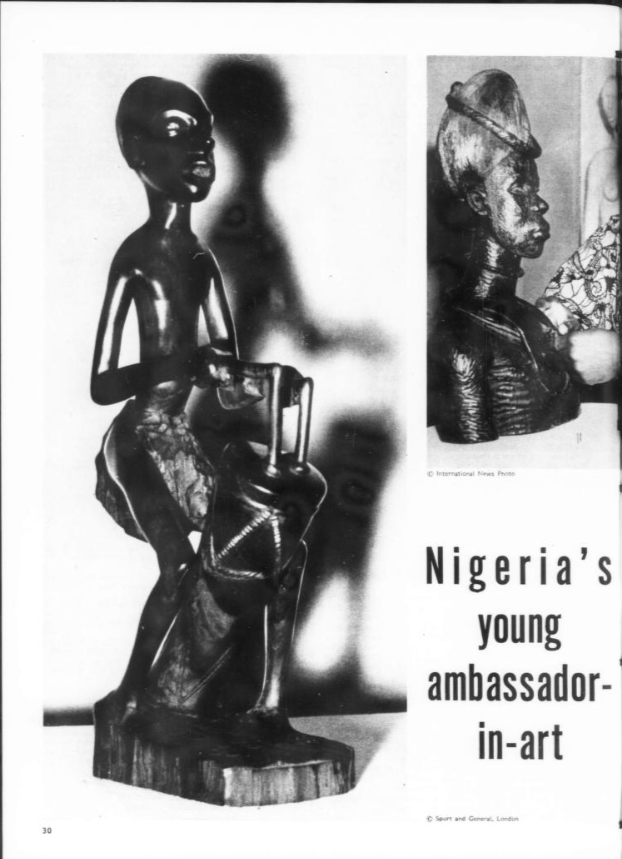
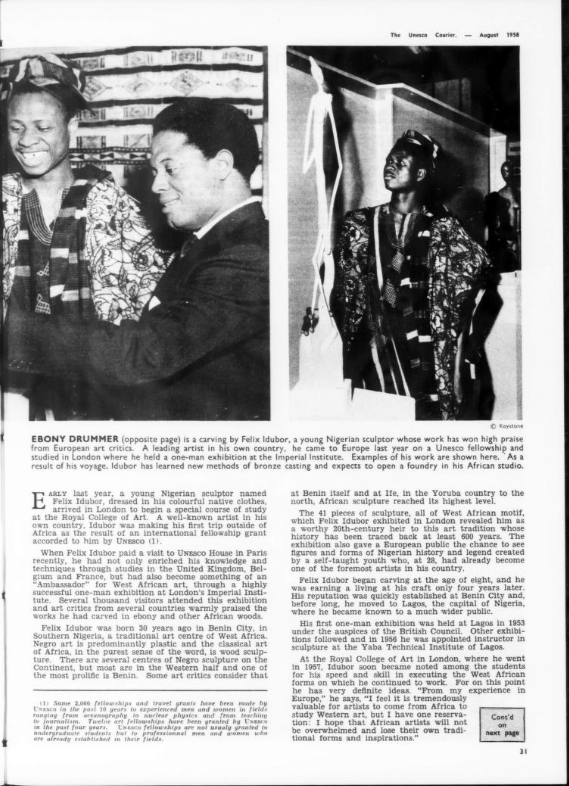
EBONY DRUMMER (opposite page) is a carving by Felix Idubor a young Nigerian sculptor whose work has won high praise from European art critics. A leading artist in his own country, he came to Europe last year on a UNESCO fellowship and studied in London where he held a one-man exhibition at the Imperial Institute. Examples of his work are shown here. As a result of his voyage, Idubor has learned new methods of bronze casting and expects to open a foundry in his African studio.
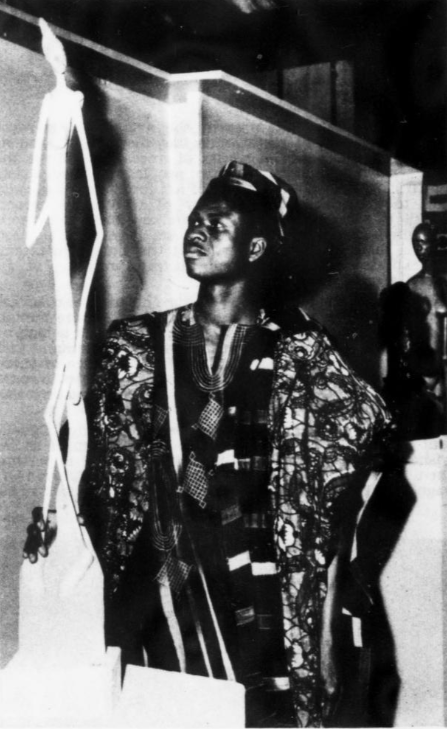
EARLY last year, a young Nigerian sculptor named Felix Idubor, dressed in his colourful native clothes, arrived in London to begin a special course of study at the Royal College of Art. A well-known artist in his own country, Idubor was making his first trip outside of Africa as the result of an international fellowship grant accorded to him by UNESCO (1).
When Felix Idubor paid a visit to UNESCO House in Paris recently, he had not only enriched his knowledge and techniques through studies in the United Kingdom, Belgium and France, but had also become something of an “Ambassador” for West African art, through a highly successful one-man exhibition at London’s Imperial Institute. Several thousand visitors attended this exhibition and art critics from several countries warmly praised the works he had carved in ebony and other African woods.
Felix Idubor was born 30 years ago in Benin City, in Southern Nigeria, a traditional art centre of West Africa. Negro art is predominantly plastic and the classical art of Africa, in the purest sense of the word, is wood sculpture. There are several centres of Negro sculpture on the Continent, but most are in the Western half and one of the most prolific is Benin. Some art critics consider that at Benin itself and at Ife, in the Yoruba country to the north, African sculpture reached its highest level.
The 41 pieces of sculpture, all of West African motif, which Felix Idubor exhibited in London revealed him as a worthy 20th-century heir to this art tradition whose history has been traced back at least 600 years. The exhibition also gave a European public the chance to see figures and forms of Nigerian history and legend created by a self-taught youth who, at 28, had already become | one of the foremost artists in his country.
Felix Idubor began carving at the age of eight, and he was earning a living at his craft only four years later. His reputation was quickly established at Benin City and, before long, he moved to Lagos, the capital of Nigeria, where he became known to a much wider public.
His first one-man exhibition was held at Lagos in 1953 under the auspices of the British Council. Other exhibitions followed and in 1956 he was appointed instructor in sculpture at the Yaba Technical Institute of Lagos.
At the Royal College of Art in London, where he went in 1957, Idubor soon became noted among the students for his speed and skill in executing the West African forms on which he continued to work. For on this point he has very definite ideas. “From my experience in Europe,” he says, “I feel it is tremendously valuable for artists to come from Africa to — study Western art, but I have one reservation: I hope that African artists will not be overwhelmed and lose their own traditional forms and inspirations.”
He points out that most of the arts of Africa were inspired by ancient secret cults like the “Ju-ju”, and as such they depicted the spirits of ancestors. “Until the last century,” he says, “wealthy people supported artists in Africa. They bought works of art for their secret cults and to keep alive the memory of traditional heroes. Artists in African communities were kept busy; they were honoured and respected by all. Art in Africa is based on the inspiration of the artist at the time of creation. He expresses his feeling and his interpretation of an object spontaneously.”
Perhaps the most striking of the ancient works of art produced in Benin are the bronzes, either life-size human heads or complete models of animals and human beings, or again, reliefs of complete scenes, animals, humans and mythological or magical symbols. The existence of these bronzes only became generally known in Europe towards the end of the 19th century, although brass casting waS introduced into Benin in about 1280 A.D.
The ruler of Benin at that time, Oba (King) Oguola sent to the Yaruba city of Ife for a brass-smith as he wished to produce bronzes himself instead of importing them from Ife. (See THE ‘UNESCO COURIER, July 1957, page 18.) The craftsman who came to Benin was named Iguo-igha. He was a very skilful worker and left many designs to his successors. As a result he was deified and is worshipped to this day by brass-smiths. A later ruler, Esigue (c.1504) is said to have encouraged and improved brass working until the art of Benin reached its prime in the 16th century. Ivory and wood carving had already been introduced by an earlier king.
Benin was visited in the 15th century by a Portuguese navigator, Alfonso d’Aveiro and later by other European voyagers. At one time it was thought that the brass casting had actually been introduced by Europeans, and there was also a theory that it had come by a roundabout route from India. But dating of the earlier Benin bronzes shows that the people of Benin (the Bini) practised this art before the arrival of the Portuguese. This is another aspect of Nigeria’s art tradition that fascinates Felix Idubor. As well as teaching young Nigerian artists something of what he has learned in England and on the Continent, he now wants to set up a bronze foundry in his Lagos studio. “I have now learned new methods of bronze casting which will enable me to work faster and compete with established foundries,” he says.
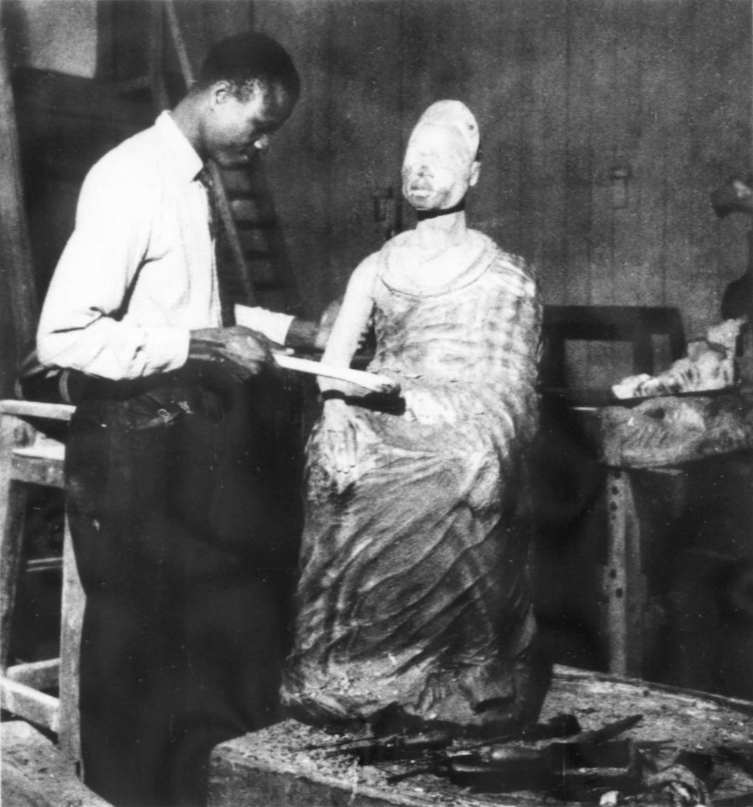
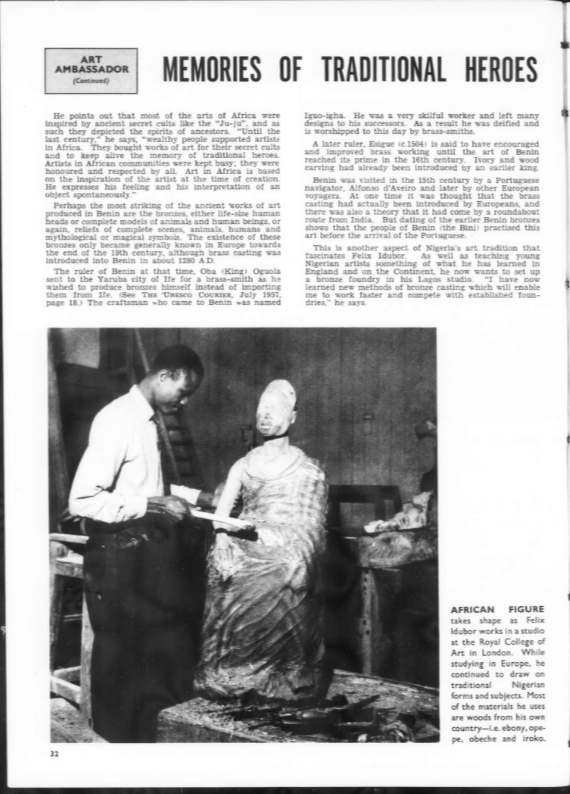
AFRICAN FIGURE takes shape as Felix Idubor works in a studio at the Royal College of Art in London. While studying in Europe, he continued to draw on traditional Nigerian Forms and subjects. Most of the materials he uses are woods from his own country – i.e. ebony, opepe, obeche and iroko.

Leave a Reply