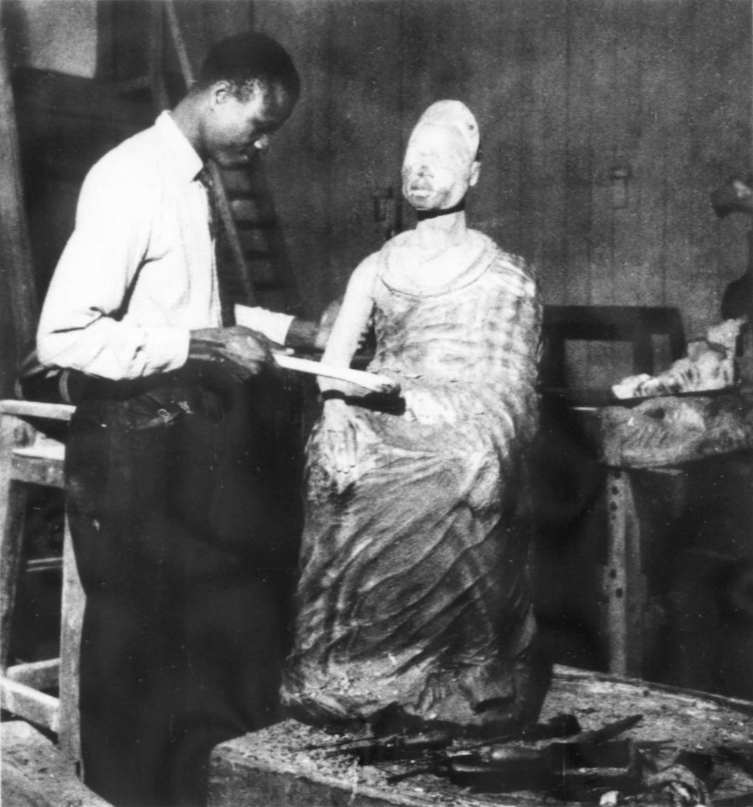
Y. A. Grillo and Juliet Highet
African Arts Vol. 2, No. 1 (Autumn, 1968)
, pp. 30-35 (6 pages)
Published By: UCLA James S. Coleman African Studies Center
The tradition of art in Benin is an old and honored one. No other city in Africa identifies its name so completely with an artistic culture. Its artists once formed professional guilds which gained them high prestige in their society.
The Benin bronze heads and high reliefs are among the greatest treasures of African art. For centuries this kingdom was renowned for its power and culture, which reached a climax under the rule of Ewuare, the Oba of Benin (1440-1473). He was celebrated as a warrior, physician, and traveller, and it was during his reign that the first explorer, Ruy de Sequeira, arrived and brought Benin into contact with Europe.
This notable civilization continued until the city was destroyed in 1897. The British, in a punitive expedition, sacked the town, and much of the art was damaged. Much more was looted and has ended up in the scattered collections of museums and private art collectors in Europe.
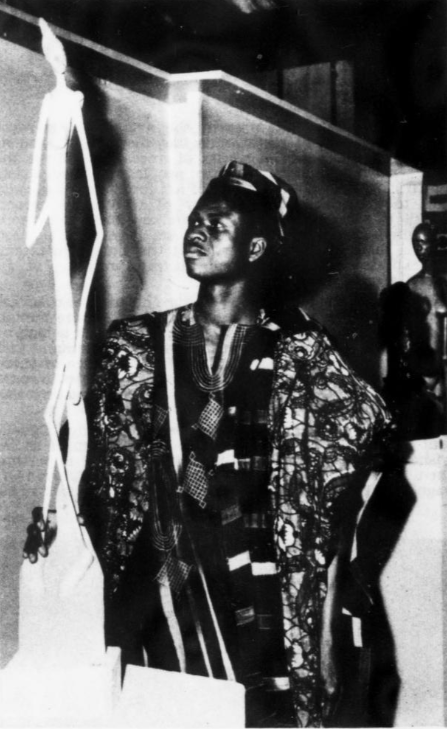
Although the original tradition is now long distant, there are still significant works of art produced in Benin. A young aspiring artist cannot help but be aware of the proud tradition that is his heritage, and there are many impressive artists in contemporary Nigeria from all regions and in all art forms. There are poets such as J. P. Clark, dramatists such as Wole Soyinka, painters such as Uche Ocheche. Of this new group, one of the most interesting is the Benin sculptor, Felix Idubor, whose work has attracted serious attention.
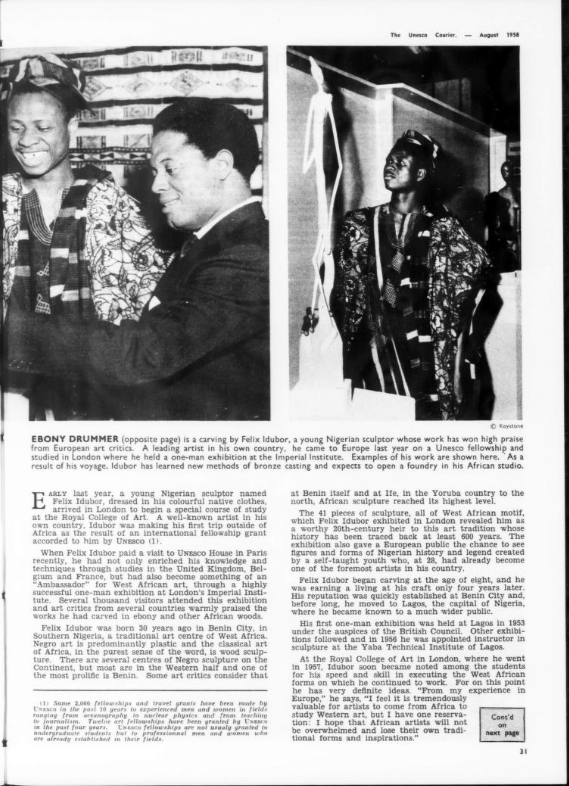
This young sculptor, still under 40, was born in Benin and has always been concerned in the artistic life of his city. Even at the very early age of eight he chose his profession as a carver by an instinctive sense of his natural creative bent. In spite of opposition from a parent who felt that the family farm should be his metier, it is claimed that from the age of twelve, when he left school, he was able to support himself with his carvings in the choice ebony and iroko woods from the trees common around Benin. Even allowing for the fact that there is often exaggeration in anecdotes about the life of a child genius, it is certain that by the age of seventeen, although he had had only six years of formal schooling at the Benin Apostolic School, he was appointed to teach sculpture at Edo College in his city.
In 1945 he left Benin, drawn to the federal capital at Lagos, where he set up his new studio. There he faced the same difficulties in becoming established that many other artists have found in coming to a capital city. In Africa there is one way, at least, for the young artist to make a living, although at some cost to his aesthetic principles -the manufacture of tourist art. So Idubor set up a center, more craft than art, where he admits he engaged in “producing the conventional bread and butter lines carried around by the Hausa traders,” in street stalls across the African continent.
But for Idubor this was only a temporary way to earn his livelihood, and he continued his development as a genuinely sensitive artist. This enabled him to hold his first exhibition in the Nigeria Exhibition Center in 1953. The show was the more remarkable in that it was the first exhibition devoted to wood sculpture ever held at the USIS library. This brought his work to the attention of American collectors, who acquired pieces of his carving. The collection also attracted international critical attention, and his potential was no longer to be doubted. But it was his major show in 1956 that established him as an artist and gained him the support and recognition that his work demanded.
The show was opened by Sir James Robertson, then the British Governor-General of Nigeria. From its success came commissions and other opportunities for which Idubor had long worked. The exhibition coincided with the visit of Queen Elizabeth to Nigeria and the gifts made to her by the Nigerian Government as a souvenir of her visit included a superbly carved chest – the work of Felix Idubor. Other successes followed. He was appointed instructor in art at the Yaba Technological Institute and won a UNESCO scholarship which enabled him to undertake formal art study at the Royal College of Art in London. A display of his work was held at the Imperial Institute. He was then able to travel in Europe, before returning to Nigeria to execute his first major commission: the carving of the entrance doors of the cooperative bank in Ibadan. The brilliant British architect Maxwell Fry had already established a reputation with his building in the Punjab capital. Having been commissioned to design the new bank in Ibadan, he sought a Nigerian artist and recognized the talent of Felix Idubor. He requested him to create the doors. They are carved in relief upon wood and depict the three main regions of Nigeria, each one symbolized by the major crop of the area: the northern ground nuts; the eastern palm fruit; and the western cocoa.
The immense success of this task brought him other similar commissions, among them the door of the Iaga Idungan-the palace of the hereditary Obas of Lagos. His carved panels also decorate the walls and throne of the National Hall in Lagos. He has experimented in other materials, and his tender carving of the head of a Yoruba girl, done in Italian marble, is now displayed in Nigeria House in London.
Further study took Idubor to Germany, as the first Nigerian to be awarded a scholarship at the Munich University Institute of Art. The work he presented there was enthusiastically received by the German-Africa Society.
In 1966 Idubor celebrated the opening of his art gallery, the first contemporary gallery of its kind in Nigeria. For this purpose he took over a handsome, century-old house in Kakawa Street and called it “The Idubor Gallery of Art.” It was an impressive building, for although it had been somewhat remodeled over the years, it still kept the vital elements of its magnificent Brazilian design: symmetric, elegant, and classical. In this gallery Idubor displays his work, including the bronzes which he casts in his own foundary in Benin where this metal-working tradition was once so vital. Many other contemporary African artists have also had their work on display in his gallery.
As Felix Idubor says of his intention, “I have taken the plunge to run an art gallery … in order … to restore our loss of artistic consciousness and to show art as an integral part of our life.” The gallery itself is only a place for display. It is the carving of Idubor and other contemporary artists which will achieve for Nigeria this declared purpose, and the career of Felix Idubor has already helped to restore the memory of the great art tradition of his city.
Appreciations of Idubor
Y. A. GRILLO
In many African countries which have recently achieved political independence, perhaps the greatest retarding factor in the contemporary creative progress (and this has been phenomenal in Nigeria) is the superfluous effort being made to define national identities. This politically desirable aim often forms the philosophy of many a contemporary artist, with the sad result that sincere creative urges are replaced by overconsciously chauvinistic syntheses.
Felix Idubor, happily, in spite of what must be an overwhelming pressure from uninformed critics and collectors who would want artists to produce what they think should come out of Africa in the contemporary scene, has evolved in his sculpture a style which is primarily Idubor and which is very distinctive. Felix would prefer that his art be re-garded as “Benin/Nigerian art.” However, no worthwhile critic is going to do him the disservice of wasting words on an axiom and neglecting to say that only Felix can produce those superbly carved, graceful sculptures in ebony the way he does.
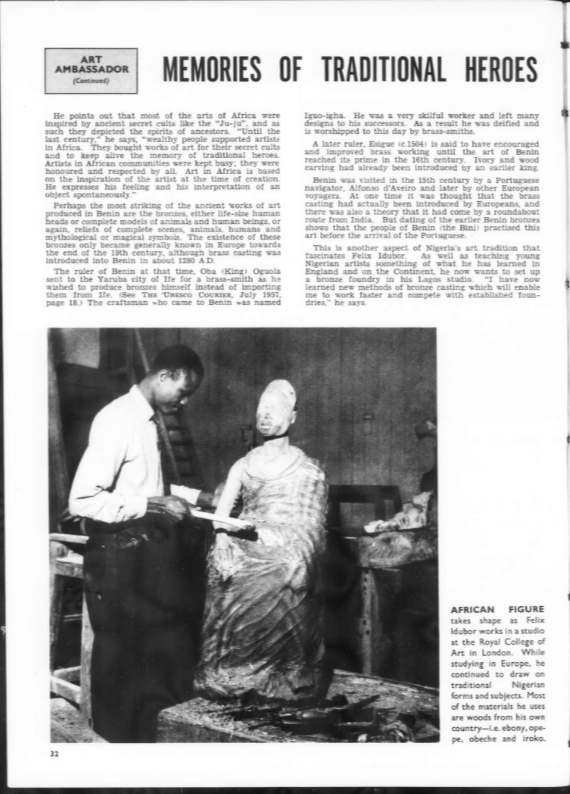
Felix worked for years producing exquisite but unimaginative works, apparently because they sold more quickly to undiscerning tourists or those who just wanted something for the mantlepiece: he had found that it was very expensive living in Lagos. By 1953, he had made enough money to enable him to tread more creative paths. The artist Idubor, as distinct from the craftsman, began to emerge. His one-man exhibitions followed one another in quick succession between 1953 and 1957, when he won a UNESCO Travelling Award which took him to the Royal College of Art in London, and Europe. It was when he was working at the Royal College of Art that the renowned British sculptor, Sir Jacob Epstein, made his famous remark that Felix should not be exposed to the dangers of the western system of art training – he should be put on the next boat home! Sir Jacob’s words have been remembered through the over-publicized interpretation some chauvinists gave to them: African art is something special, something distinct from all other art. The African artist cannot and should not learn only from European schools – but Felix is obviously full of admiration for academic naturalistic representation, as can be seen in his efforts in cement, cement fondu, and bronze.
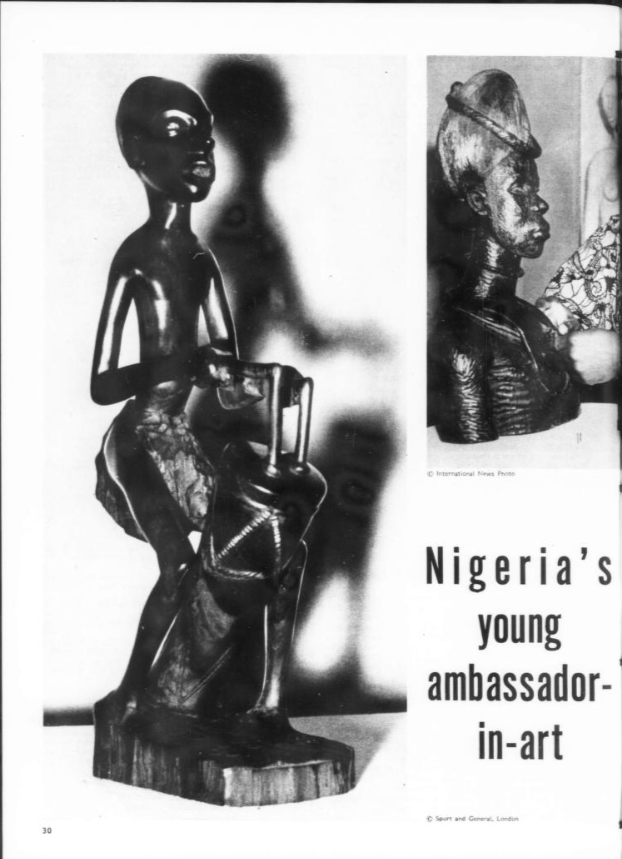
As an artist, Idubor is most effective in wood. He is a superb craftsman; it is not an overstatement to say that he performs wonders with chisel and ebony. His subjects -mostly portraits of characters from the very rich Benin tradition are elegant, graceful, and modestly elongated. Felix has also done a number of carved door panels for public buildings all over Nigeria. He is a very fast worker, and knows it: “People see me almost always on the road and wonder when I work! But they come to the studio for five minutes and they are surprised how much work has been done.”
Felix is successful. His entire studio was bought up by an American collector in 1961. His works are continually being exhibited in Nigeria, Britain, Germany, and America. He works in his studio at King George V Road and owns a Gallery on Kakawa Street which shows his works and those of other artists. Felix is regarded as a leader by all Benin carvers in Lagos. He has strong ideas about art training in colleges: “Art training should be fashioned to perpetuate the country’s traditions.” It is therefore no surprise that he cannot stand “this modern abstract stuff.”
JULIET HIGHET
Ever since Picasso, Braque, and their contemporaries found inspiration in African art, international interest in it has grown. In particular, the work that has come from two Nigerian towns, Benin and Ife, has long been respected. A large proportion of present-day Nigerian artists come from the western states, mainly from Benin. Among them are musicians, dramatists, and authors, as well as painters and sculptors, whose styles are largely abstract and semi-abstract.
Some artists lean heavily on Western influences, assimilated while abroad. One sculptor, however, Felix Idubor, prefers working in a traditional way. His aim is to perpetuate through his art the great artistic and cultural traditions of Benin. An example of this is his representation, in plaques, of the ruling hierarchies of the Obas (kings) and their courts. And it is interesting to note that Idubor’s grandfather was fourth in rank to one of the Obas of Benin. Unlike most Nigerian sculptors, he is not descended from a long line of craftsmen, yet from an early age he was determined to carve. His father, a farmer, did not understand these early ambitions and tried actively to discourage him from taking up sculpture, calling it “a lazy man’s occupation.” As a child, Felix began carving birds in soft wood. At the age of eight, when he found that the cover of a much-loved container, carved in the shape of a dove, was broken, he decided to recarve it in hardwood. Now Idubor prefers to use hardwood, forcing it into the shape he requires, rather than regarding the block as having an intrinsic conceptual life of its own. Today Idubor maintains a studio in which apprentices carry out the rough work on his sculpture. But in a courtyard behind his house, he also works on pieces the production of which he wishes to control entirely.
Felix Idubor has recently written an article on Benin in which he declares that one of his aims is to keep its tradi tions alive through his own work. He is also deeply concerned about the art education of Nigerians. Even though they may be financially unable to buy his work, he feels they should not lose sight of their own artistic and cultural background-this is a matter of particular importance in Africa during this era of change. Idubor showed me a recent carving of a woman and child to illustrate the type of work with which he feels Nigerians can identify, maintaining that this can best be done by means of representational rather than abstract techniques, which do not interest him greatly.
As far as human problems and politics are concerned, he is not personally interested or involved. “They have nothing to do with my way of life as an artist,” he says. Yet he continues with his carving, using his Benin-influenced background for the edification of all Nigerians.
Images on page
THE CRIPPLE
COLLECTION OF MRS. ADULEE MOORE
BOY EIGHT
COLLECTION OF D.R. AND MRS. JERRY WULK
FULANI WOMAN
DOORS, HOUSE OF PARLIAMENT, LAGOS.
TOP: KANO GROUNDNUT PYRAMID
CENTER: PALM NUT FARMER FROM EASTERN NIGERIA
BOTTOM: COCOA AND RUBBER FROM WESTERN NIGERIA
DOOR, HOUSE OF PARLIAMENT, LAGOS
TOP: NATIVE DOCTOR HEALING THE SICK WITH HERBS
CENTER: EDUCATOR TEACHING CHILDREN TO READ KORAN
BOTTOM: A CARVER AT WORK
FULANI GIRL. IN THE RESIDENCE OF THE
BRITISH HIGH COMMISSIONER IN LAGOS
DOORS, HOUSE OF PARLIAMENT, LAGOS.
MALE AND FEMALE SPIRITS OF THE IROKO TREE
WOMAN AND CHILD