Mentions in ‘Reading the Contemporary: African Art from Theory to the Marketplace’

Reading the Contemporary : African Art from Theory to the Marketplace, 1999

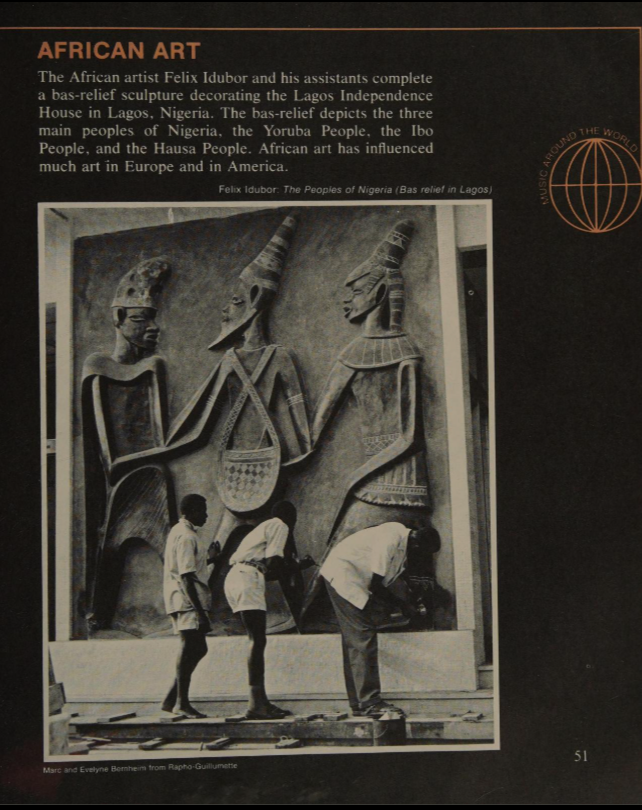
…Admittedly, there was a time, around 1960, when the greater part of available patronage was expatriate. Some artists preferred to keep their paintings themselves rather than sell them to expatriate collectors, who were likely to take them out of the country, but this is no longer the case. With the construction of the Independence Building at the western end of the Lagos racecourse, and its use of work by Nigerian artists, a revolution in patronage was instituted, the fruits of which can be seen all over Lagos and throughout Nigeria. There are several public and private collections, and there are Nigerian professional art brokers. Perhaps this patronage is still not enough; perhaps it never will be enough, but both state and individual patronage are evident for all to see. Sometimes, though, one’s seeing can be misconstrued, as, for example, Cosentinos reference to Yoruboid Pharaohs, which are, in fact, relief sculptures on the Lagos Independence building by Felix Idubor a non-Yoruba sculptor…
Entry in ‘Nigerian Artists: A Who’s Who’

Nigerian Artists: A Who’s Who and Bibliography, 1993

by Kelly, Bernice M; Stanley, Janet L;
Smithsonian Institution. Libraries. National Museum of African Art Branch

Continue reading “Entry in ‘Nigerian Artists: A Who’s Who’”

Mentions in ‘African Art: The Years since 1920’

African Art: The Years since 1920 by Marshall W. Mount, 1989

Continue reading “Mentions in ‘African Art: The Years since 1920’”

Pictured in the ‘New Dimensions in Music: Investigating Music’ school songbook

New Dimensions in Music: Investigating music, 1980

AFRICAN ART

The African artist Felix Idubor and his assistants complete a bas-relief sculpture decorating the Lagos Independence House in Lagos, Nigeria. The bas-relief depicts the three main peoples of Nigeria, the Yoruba People, the Ibo People, and the Hausa People. African art has influenced much art in Europe and in America.

Felix Idubor: The Peoples of Nigeria (Bas relief in Lagos)

Mentioned in ‘Primitive Art’

‘Primitive Art’ by Leonhard Adam, 1963

As a sculptor, the African has little or nothing to learn from the European. Pl. 40a shows a modern sculpture in iroko wood by B. C. Enwonwu, then a twenty-year-old student of Onitsha and Government College, Umuahia (Nigeria), who was described as the most sophisticated of the five artists who were represented by wood carvings, terracottas, and water-colours at a Nigerian art exhibition, held at the Zwemmer Gallery in London, 1937. The artists had been trained ‘on methods adapted from those made familiar by Miss Richardson of the London County Council’. We see correct proportions according to European academic-naturalistic standards; in fact, this is a work which could have been done by a European. It is true that this sculpture represents an African woman but it cannot be claimed that this is an example of genuine African art. All the spontaneity and vigour of real African art, as we perceive it on Pls. 2 to 7 and elsewhere, is gone, it is obscured by acquired European academic convention. This can hardly be called ‘progress’, although it is interesting as a result of the impact of European vision and technique. Another modern Nigerian artist is Felix Idubor (born as the son of an Edo farmer at Benin City in 1928). Idubor, too, has learned his European lesson; but, in addition to academic statuettes illustrating native life, he has retained, or revived, in some of his works, the true African spirit, as could be seen from carvings like his mask representing a dream, which was on exhibition at the Imperial Institute in 1957.

Listed among men of stature in West Africa

‘Britain’s Purpose in Africa’ by Sir Kenneth Bradley, 1959

Men of stature in West Africa. (Above, left) The late E. S. Beoku-Betts, a Sierra Leone judge. (Right) Mr. Felix Idubor, the famous sculptor from Western Nigeria. (Below, left) The consecration of Bishop Martinson, the first Gold Coast African to become a Bishop. (Right) Dr. E. J, Lawson, of the orthopedic hospital, Igbobi, Nigeria.