In Minneapolis Institurte of Arts
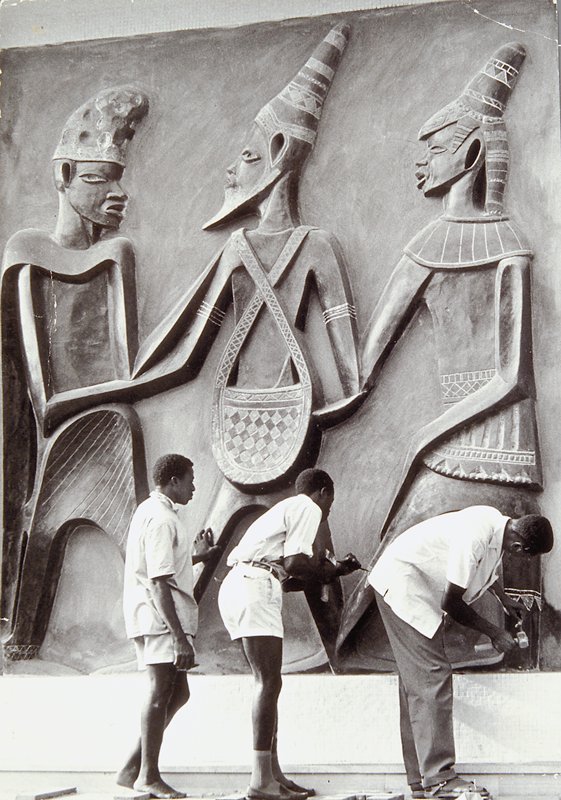
© Marc and Evelyne Bernheim
Articles and other things
In Minneapolis Institurte of Arts
© Marc and Evelyne Bernheim
Reading the Contemporary : African Art from Theory to the Marketplace, 1999
…Admittedly, there was a time, around 1960, when the greater part of available patronage was expatriate. Some artists preferred to keep their paintings themselves rather than sell them to expatriate collectors, who were likely to take them out of the country, but this is no longer the case. With the construction of the Independence Building at the western end of the Lagos racecourse, and its use of work by Nigerian artists, a revolution in patronage was instituted, the fruits of which can be seen all over Lagos and throughout Nigeria. There are several public and private collections, and there are Nigerian professional art brokers. Perhaps this patronage is still not enough; perhaps it never will be enough, but both state and individual patronage are evident for all to see. Sometimes, though, one’s seeing can be misconstrued, as, for example, Cosentinos reference to Yoruboid Pharaohs, which are, in fact, relief sculptures on the Lagos Independence building by Felix Idubor a non-Yoruba sculptor…
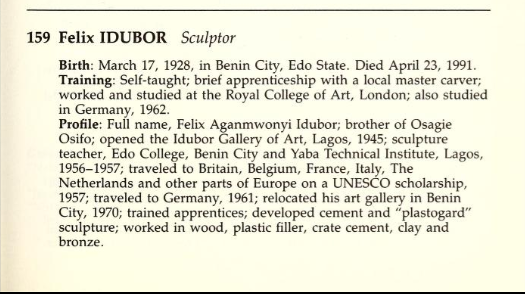
Nigerian Artists: A Who’s Who and Bibliography, 1993
by Kelly, Bernice M; Stanley, Janet L;
Smithsonian Institution. Libraries. National Museum of African Art Branch
New Dimensions in Music: Investigating music, 1980
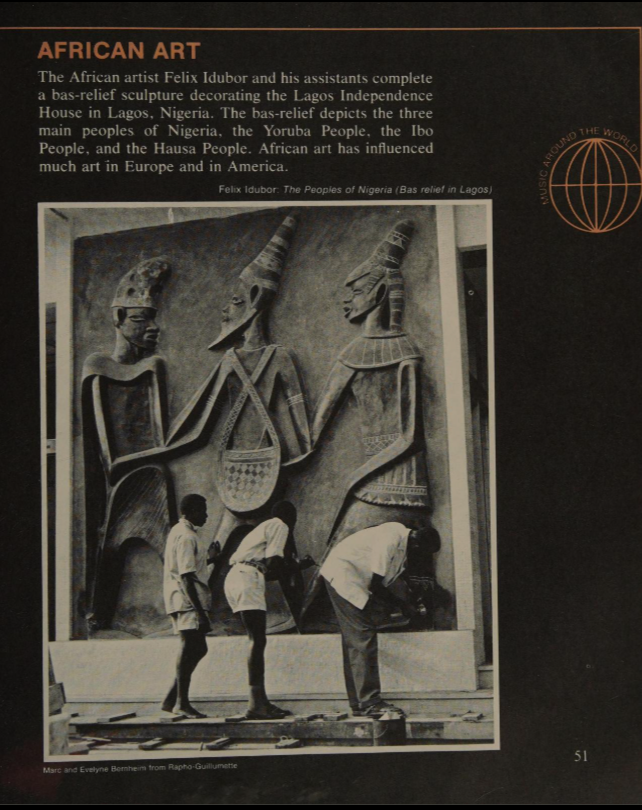
AFRICAN ART
The African artist Felix Idubor and his assistants complete a bas-relief sculpture decorating the Lagos Independence House in Lagos, Nigeria. The bas-relief depicts the three main peoples of Nigeria, the Yoruba People, the Ibo People, and the Hausa People. African art has influenced much art in Europe and in America.
Felix Idubor: The Peoples of Nigeria (Bas relief in Lagos)