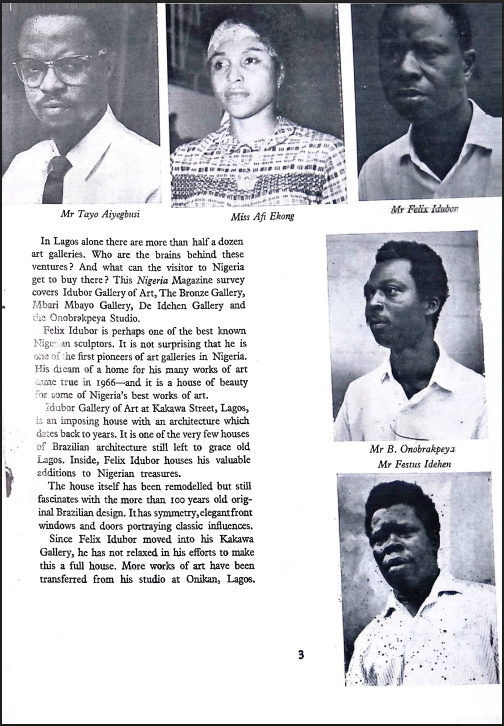
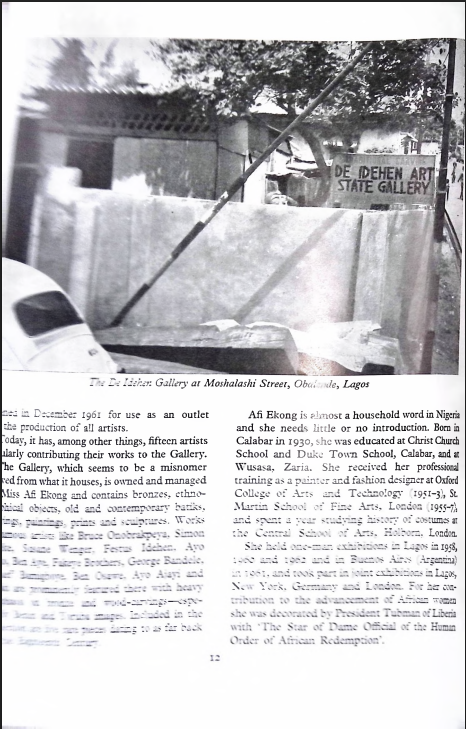
Y. A. Grillo and Juliet Highet
African Arts Vol. 2, No. 1 (Autumn, 1968), pp. 30-35
Published By: UCLA James S. Coleman African Studies Center

Articles and other things
Y. A. Grillo and Juliet Highet
African Arts Vol. 2, No. 1 (Autumn, 1968), pp. 30-35
Published By: UCLA James S. Coleman African Studies Center
[Felix Idubor’s “cement sculptures” mentionied in what was seen at the time as a seminal article on African arts by the British artist Gerald Moore.]
By Gerald Moore
African Affairs Vol. 66, No. 263 (Apr., 1967), pp. 140-148 (9 pages) – incomplete scan
THE ARTS IN THE NEW AFRICA
by GERALD MOORE, University of Sussex
Delivered at the fourth session of the Conference of the African Studies Association of the United Kingdom in Edinburgh, September 23, 1966.
SOONER OR LATER I shall have to come to terms with that phrase which obtrudes in my title-‘the new Africa’. I have retained it because it so conveniently begs some of the questions I want to consider here. Does any artist, for instance, really inhabit a society which is new in the sense that seems to be implied? Are not all societies old, those in Africa certainly not less so than societies elsewhere?
This obstinate antiquity may be a source of embarrassment to the public propagandist, who runs about mentally putting brassières on every shining torso, but to the artist it provides a cone of fascination about which his imagination perpetually wheels and flutters. T. S. Eliot has given us the classic statement of the way in which the artist extends tradition by reacting against, yet within it. An equally important result of his reaction is that he helps to define that tradition, by restating its significance for himself and for his generation.
For some time this particular function of the artist was obscured in Africa by the urgency of the dialogue with colonialism. The demands of this dialogue may be credited with having given the first great impetus to a re-examination of African tradition and African social values, but at the same time the pressure of the debate itself often dictated what was found and how it was presented. It is generally accepted that the whole movement of négritude in French-speaking Africa, for example, can only be fully understood in relation to the colonial policies which helped to call it forth. But, despite the obvious differences in colonial policy, it is equally true that all discussion of cultural issues in English-speaking Africa was, until very recent years, conducted with at least one eye fastened on the colonial intruder. Only with his departure (if, indeed, he has departed) did it become possible for Africa to take up again the debate with herself from which a more autonomous art can grow. Today the attention of the artist in tropical Africa is directed more and more upon his own society. A book like Things Fall Apart is the work of a man who has begun to see the past steadily and see it whole. But A Man of the People, written only seven years later, marks Achebe’s attainment of the far more difficult feat of looking at the present in the same way. The first achievement was, I think, necessary to the second. An acceptance of history, a clear-eyed reunion with one’s ancestors, made it possible to see, in African terms, what had gone wrong in the estate of their descendants. On the mundane level, this finds its reflection in the historical moment when a mere display of nationalist rhetoric without results no longer enables the speaker to pose as a liberating hero; when he is called to account, not by the waning colonial power, but by his indignant fellow countrymen. This is the moment predicted and, with uncanny accuracy, described in the last pages of A Man of the People.
‘… In the affairs of the nation there was no owner, the laws of the village became powerless…. In the fat-dripping, gummy, eat-and-let-eat regime just ended – a regime which inspired the common saying that a man could only be sure of what he had put away safely in his gut or, in language even more suited to the times: ‘You chop, me self I chop, palaver finish’; a regime in which you saw a fellow cursed in the morning for stealing a blind man’s stick and later in the evening saw him again mounting the altar of the new shrine in the presence of all the people to whisper into the ear of the chief celebrant-in such a regiune, I say, you died a good death if your life had inspired someone to come forward and shoot your murderer in the chest – without asking to be paid’.
The vigour and certainty of this writing adds a new dimension to Achebe’s talent. The artist, without descending from his proper level of activity, is speaking directly to his age. There are signs that the fading dialogue with colonialism will be succeeded by an African dialogue of increasing intensity and passion, one which will seek to expose the features of its society to the keen and angry air of reality. Another recent Nigerian novel, Wole Soyinka’s The Interpreters (1965), though more metaphysical in its concern with the web of destiny around cach character’s life, is equally sharp and penetrating in its observation of the social scene. The mordant comedy of such scenes as the Professor’s cocktail party makes a perfect backdrop, setting off by its very triviality the serious relationships and self-discoveries which Soyinka unfolds among his principal characters.
The Interpreters also takes stock of current evils, corruption, licensed violence and fatuous social pretension, in a way that brings a new edge to West African fiction. But whereas the purging of these evils is almost the point of Achebe’s book, Soyinka’s leads the novel in a fresh direction by his insistence on full realization of a whole group of characters, and by his careful tracing of the effect which cach has on the others. The Interpreters taken together with a work such as Cheikh Kane’s L’Aventure Ambigue from the French-speaking sphere, suggests that African fiction may be moving out of a relatively simplist phase into something altogether more complex and challenging, something which can bear comparison in its level of organization with the best work from the Caribbean.
Dramatic Idiom
In drama, too, a forward movement is visible in the work of the past year or two. The search for an African dramatic idiom began with a display of apparent influences from far afield: Genet in Lewis Nkosi’s Rhythm of Violence, West End drawing-room comedy in Easmon’s Dear Parent and Ogre and De Graft’s Sons and Daughters, Greek and Elizabethan tragedy in Clark’s Song of a Goat, Brecht in some of Soyinka’s carly work. Of course, when these influences were filtered through an African imagination and dressed in African situations, the effect was of something fresh and exciting, and was rightly praised as such. Nor is it suggested that these influences were the only ones present in a group of works which have truly made possible the growth of a new art of the theatre in Africa.
But when we turn to recent plays like Soyinka’s The Road and Clark’s Ozibi we can see formal influences flowing in directly from African sources and shaping the dramatic structure right from the start. The Road is boldly ritualistic, particularly in the last scene, and this ritual element is not fragmented but is taken in entire (largely from the Egungun masquerade) and transmuted by the author’s purposes.
Parallel with this radicalism on the formal plane goes Soyinka’s radical use of local language, ‘deep’ pidgin, even occasional snatches of Yoruba, alternating with the vigorous but orthodox speech of Professor to give the play as a whole a very wide range of vocal idiom. The device of varying the language level of successive scenes is Shakespearean, if not older, but its use here
…
New Generation
None of this is meant in disparagement of the new generation of artists, however, who are beginning to produce works of outstanding interest in many fields. The survival of the traditional artists to work side by side with them should be the truest encouragement and inspiration they could have. For the new artists, too, must come to terms with the tradition and so help to define it for themselves.
We see this process at work in the monumental sculpture of the Ghanaian artist Vincent Akwete Kofi. His Hormplayer and his Drummer (Okyereman) freeze into an eternal gesture. Kofi’s vision of what these men have given to Akan culture. The drummer plays with his head tilted far back, drinking his message from the skies. To the gods he speaks with humility:
‘Slowly and patiently I get to my feet…I am learning, let me succeed.”
But for man he is the voice of authority, the regulator of life and time who awakens him early in the morning. The hornplayer too is a bridge between man and god, but in Kofi’s vision of him the brooding face is held low, while it is the mouth of the Rorn which rises heavenwards with its cry: ‘Master of the path, I am exposed to fire.”
Far away in Zambia another monumental sculptor has emerged whose works continually beckon us towards the other world. But Petson Lombe, like Kоfi, is at present the victim of a situation in which monumental works can expect only public commissions, and those in control of public commissions are looking only for the obvious, for the visual slogan. It is reported that Lombe recently lost the commission for the Zambia independence monument because he declined to produce a man with a hoe.
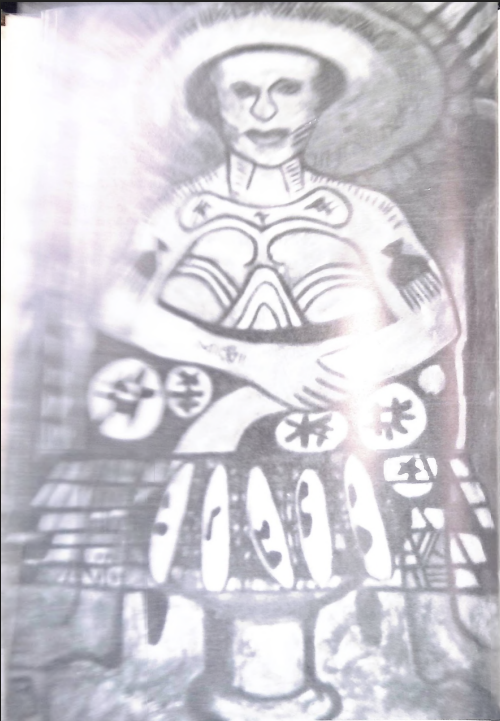
In painting, the modern artist adjusts to tradition in a hundred different ways, but he seldom ignores it. Ben Emokpae of Nigeria creates in one of his paintings a whole background of masks, flickering and glowing behind his boldly realized subject, which literally emerges from them. Demas Nwoko, in his portrait head entitled Onile Gogoro, drinks from the remotest sources of Nigerian art, drawing his formal inspiration from the Nok terracotta sculptures of the first millennium B.C.
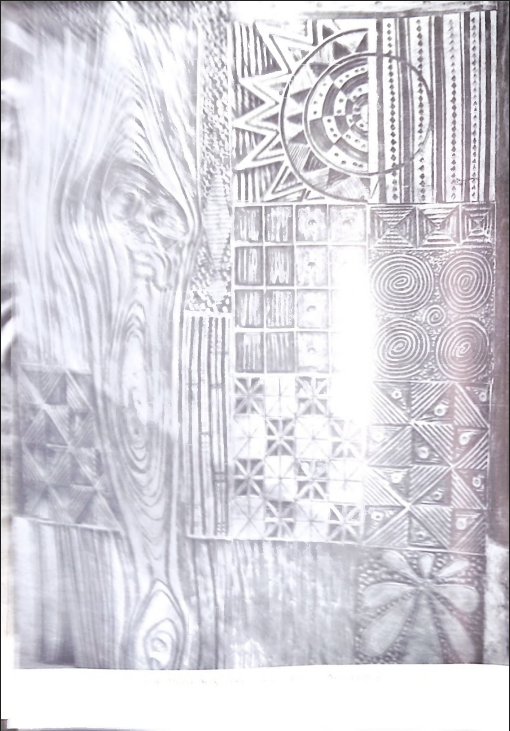
The cement sculptures of Felix Idubor, so splendidly adapted to the demands of modern architecture, as may be seen in his fine screen for the Chase Manhattan Bank in Lagos, achieves his braced, intense monumentality in precisely the manner of the traditional caryatid or …
[Incomplete scan]
The Scotsman – Monday 30 August 1965
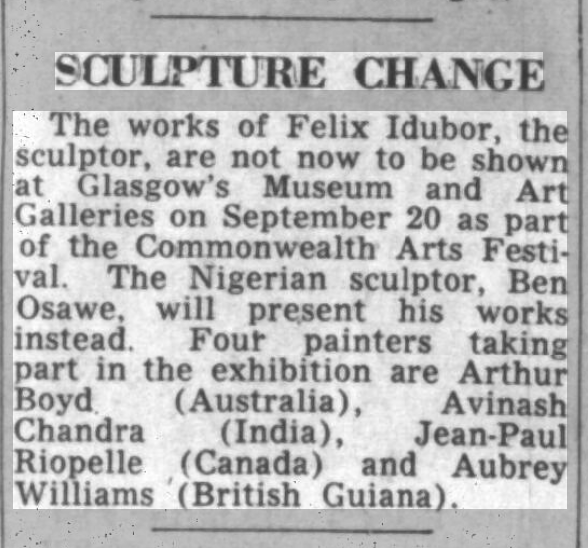
SCULPTURE CHANGE
The works of Felix Idubor, the sculptor, are not now to be shown at Glasgow’s Museum and Art Galleries on September 20 as part of the Commonwealth Arts Festival. The Nigerian sculptor, Ben Osawe, will present his works instead. Four painters taking part in the exhibition are Arthur Boyd Chandra (Australia), Avinash (India), Jean-Paul Riopelle (Canada) and Aubrey Williams (British Guiana).
The Scotsman – Saturday 16 March 1963
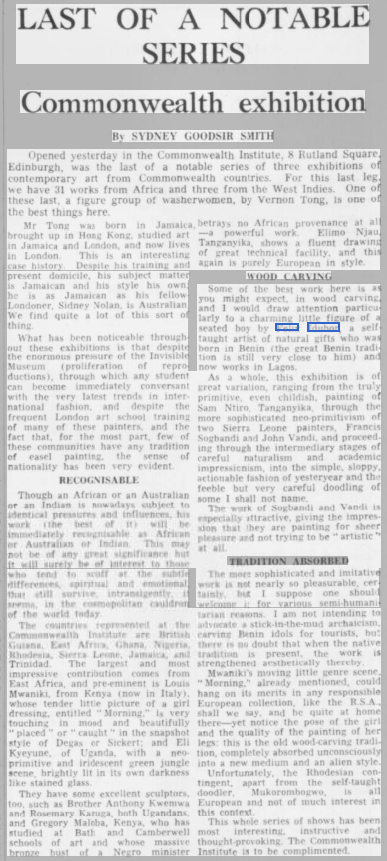
WOOD CARVING
Some of the best work here is as you might expect, in wood carving, and I would draw attention particularly to a charming little figure of a seated boy by Felix Idubor a self-taught artist of natural gifts who was born in Benin (the great Benin tradition is still very close to him) and now works in Lagos.
‘Primitive Art’ by Leonhard Adam, 1963

As a sculptor, the African has little or nothing to learn from the European. Pl. 40a shows a modern sculpture in iroko wood by B. C. Enwonwu, then a twenty-year-old student of Onitsha and Government College, Umuahia (Nigeria), who was described as the most sophisticated of the five artists who were represented by wood carvings, terracottas, and water-colours at a Nigerian art exhibition, held at the Zwemmer Gallery in London, 1937. The artists had been trained ‘on methods adapted from those made familiar by Miss Richardson of the London County Council’. We see correct proportions according to European academic-naturalistic standards; in fact, this is a work which could have been done by a European. It is true that this sculpture represents an African woman but it cannot be claimed that this is an example of genuine African art. All the spontaneity and vigour of real African art, as we perceive it on Pls. 2 to 7 and elsewhere, is gone, it is obscured by acquired European academic convention. This can hardly be called ‘progress’, although it is interesting as a result of the impact of European vision and technique. Another modern Nigerian artist is Felix Idubor (born as the son of an Edo farmer at Benin City in 1928). Idubor, too, has learned his European lesson; but, in addition to academic statuettes illustrating native life, he has retained, or revived, in some of his works, the true African spirit, as could be seen from carvings like his mask representing a dream, which was on exhibition at the Imperial Institute in 1957.
The Times, Aug 13, 1962
[AWH – Just a brief mention. But does this mean Felix Idubor’s work was shown at this Congress?]
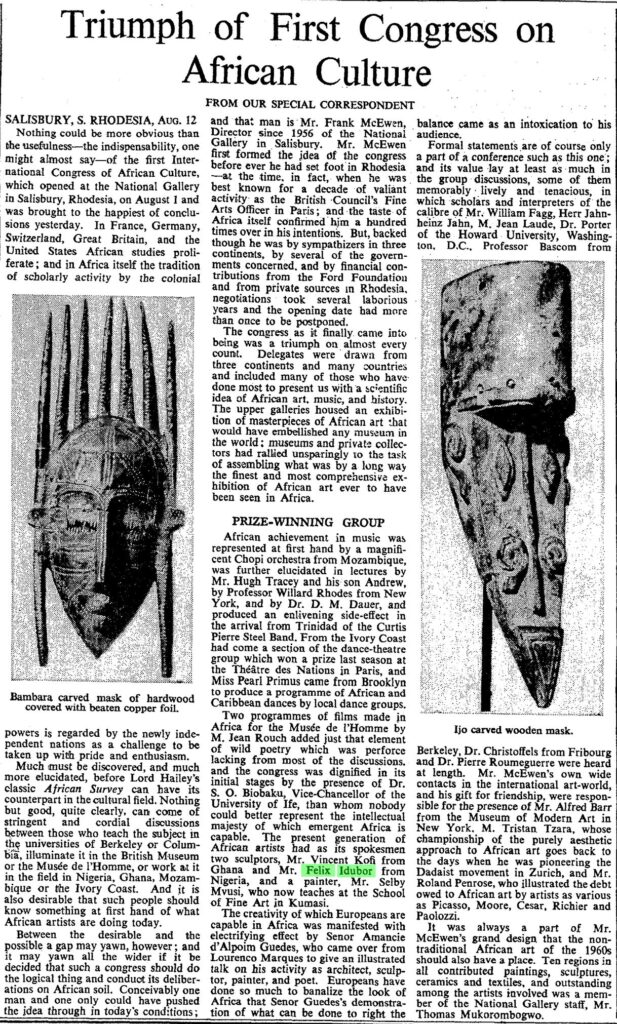
The present generation of African artists had as its spokesmen two sculptors, Mr. Vincent Kofi from Ghana and Mr. Felix Idubor from Nigeria, and a painter, Mr. Selby Mvusi, who now teaches at the School of Fine Art in Kumasi.
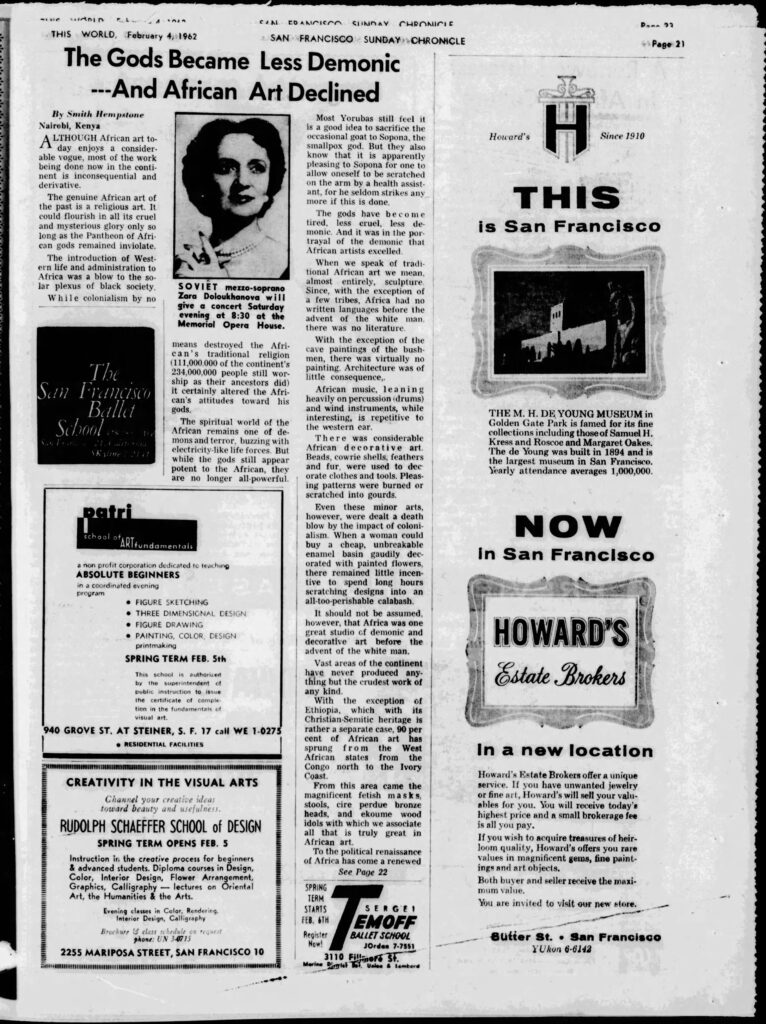
San Francisco Chronicle, Sunday, February 04, 1962
California Eagle, Los Angeles, Thursday, June 15, 1961
[reference to “Nigeria’s modernist Felix Idubor”]
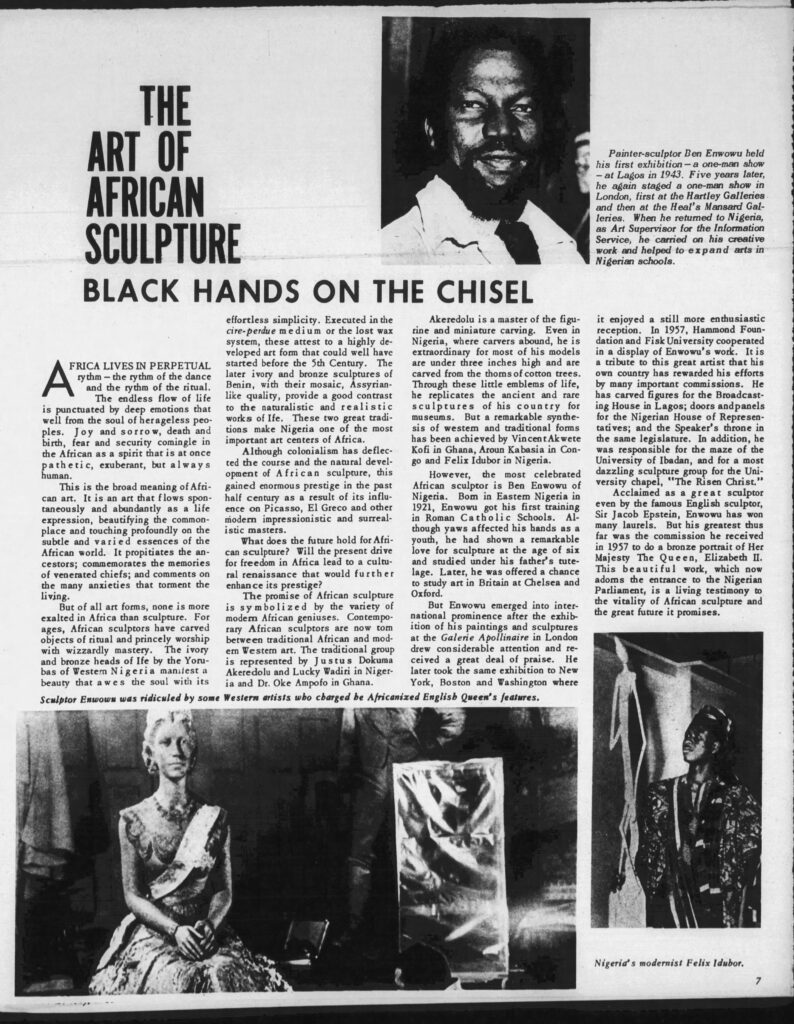
Africa Quarterly April-June 1961: Vol 1 Iss 1
HARSIMRAN MALIK
Art in Nigeria today is passing through a period of adaptation, of experimentation, of rediscovery. In the past, Nigeria’s greatest contributions to world culture were its arts of wood carving and bronze casting and masks – its traditional arts, which in the early twentieth century influenced European painters including Vlaminck, Derain, Picasso and Modigliani, who found in these art forms a strength of creativity which made the representative conventions of European art seem rigid and sterile.
But in Nigeria today, as in so many other countries which have only recently regained their political freedom, there is going on an intellectual struggle between the many who feel that the traditional arts should be repudiated as reminders and remnants of archaic, backward ways of life, which must give way to completely new and better ways, and the comparatively few who recognize the value of ancient traditions in helping to build a stable and sound modern Nigeria.
Continue reading “Art in Nigeria”