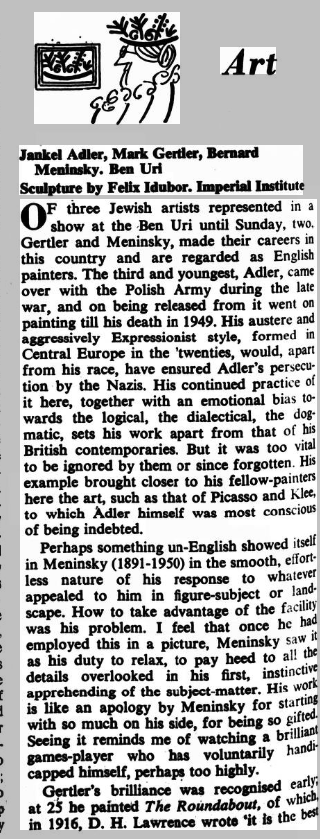
Donald Potter, a sculptor who works mainly in wood, will describe the characteristics of various kinds of wood and demonstrate the tools children will need. He will begin to carve a bird in fruit wood, to be seen again as it develops. The illustrations will include work by Felix Idubor, a Nigerian at present in London, some abstract carving, a Russian horse and totem poles.
Idubor (Imperial Institute till Sunday) comes from, and on the expiry of his Unesco travelling scholarship returns to, a country with a high tradition of sculpture, Nigeria. Of his will to master and apply this to new purposes, his fantastic wooden wall-masks are now the strongest sign.
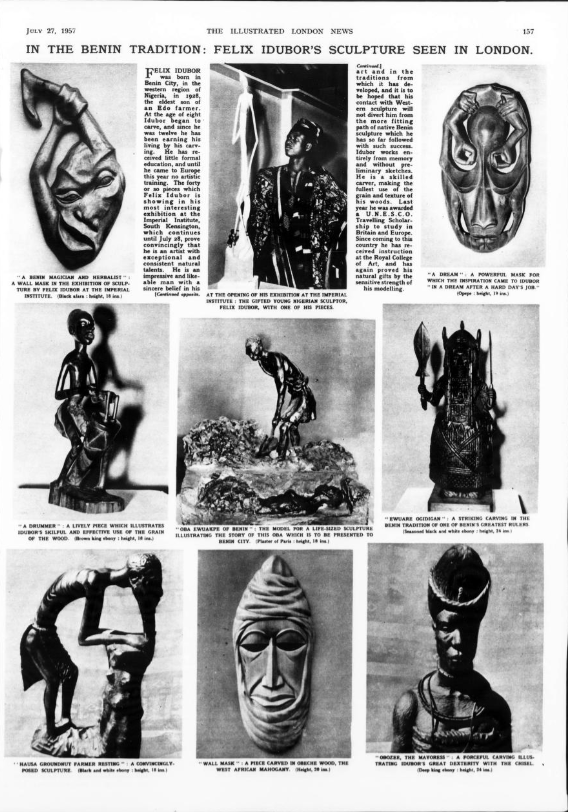
A sculpture show of exceptional interest is at the Imperial Institute till July 28. The sculptor is Felix Idubor, who was born in Benin, Nigeria, the art of which influenced European artists. and Modigliani in particular, so powerfully and so profitably. It has by now become a two-way traffic and, to Western eyes at least, Mr. Idubor’s least interesting work is that which is touched by European representationalism. But his elongated female figures in obeche, a very light wood, have a grace all their own. There is a life-size figure in this style, and a smaller one that is even more exquisite, single-breasted, with double-jointed arm behind the head.
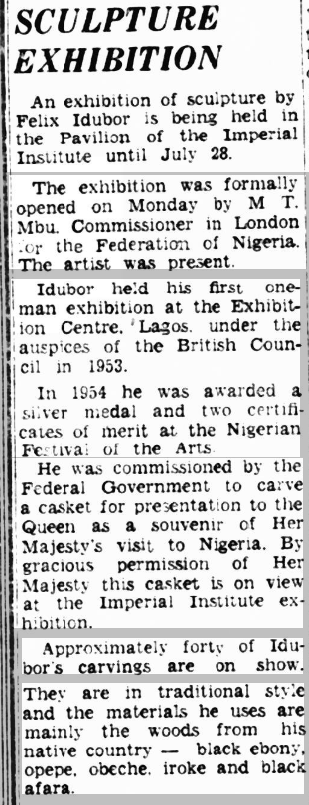
An exhibition of sculpture by Felix Idubor is being held in the Pavilion of the Imperial Institute until July 28.
The exhibition was formally opened on Monday by M.T. Mbu. Commissioner in London For the Federation of Nigeria. The artist was present.
Idubor held his first one-man exhibition at the Exhibition Centre, Lagos, under the auspices of the British Council in 1953.
In 1954 he was awarded a silver medal and two certificates of merit at the Nigerian Festival of the Arts
He was commissioned by the Federal Government to carve a casket for presentation to the Queen as a souvenir of Her Majesty’s visit to Nigeria. By gracious permission of Her Majesty this casket is on view at the Imperial Institute exhibition.
Approximately forty of Idubor’s carvings are on show.
They are in traditional style and the materials he uses are mainly the woods from his native country black ebony. opepe, obeche. iroke and black afara.
African sculpture has certain inestimable virtues in European eyes, and European taste is inclined to be distinctly plus royaliste que le roi when it sees some young African artist letting slip any part of his great, inherited tradition. Mr. Felix Idubor, a Nigerian sculptor whose carvings are being shown at the Imperial Institute, South Kensington, until July 28, is self-taught and extremely conscious of his artistic, as well as his historical, background, but there are enough indications of European sophistication in his style partly to divorce his work in spirit from the fully African elements which are its subject.
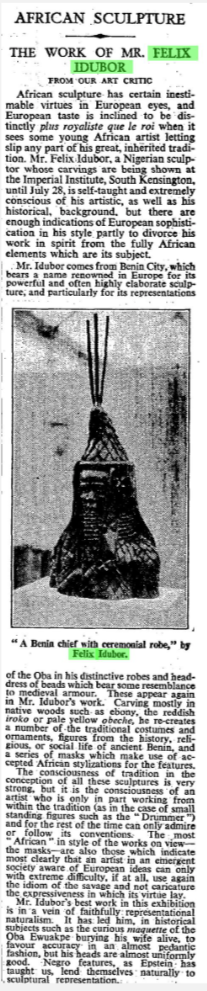
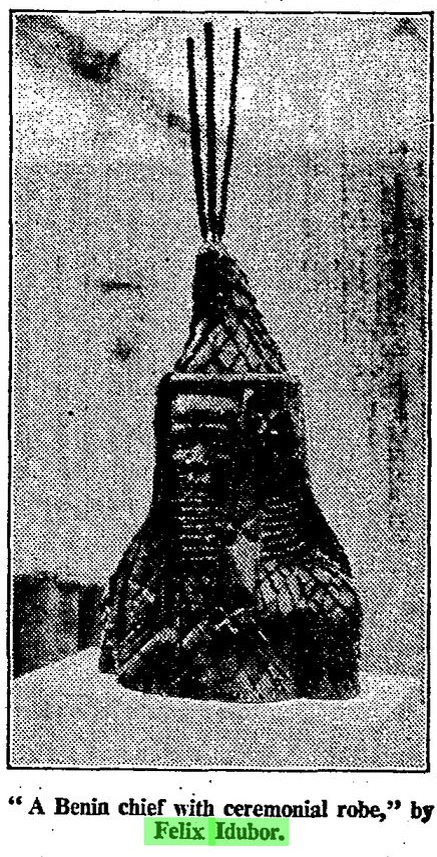
Mr. Idubor comes from Benin City, which bears a name renowned in Europe for its powerful and often highly elaborate sculpture, and particularly for its representations of the Oba in his distinctive robes and head-dress of beads which bear some resemblance to medieval armour. These appear again in Mr. Idubor’s work. Carving mostly in native woods such as ebony, the reddish iroko or pale yellow obeche, he re-creates a number of the traditional costumes and ornaments, figures from the history, religious, or social life of ancient Benin, and a series of masks which make use of accepted African stylizations for the features.
The consciousness of tradition in the conception of all these sculptures is very strong, but it is the consciousness of an artist who is only in part working from within the tradition (as in the case of small standing figures such as the “Drummer”) and for the rest of the time can only admire or follow its conventions. The most “African” in style of the works on view – the masks – are also those which indicate most clearly that an artist in an emergent society aware of European ideas can only with extreme difficulty, if at all, use again the idiom of the savage and not caricature the expressiveness in which its virtue lay.
Mr. Idubor’s best work in this exhibition is in a vein of faithfully representational naturalism. It has led him, in historical subjects such as the curious maquette of the Oba Ewuakpe burying his wife alive, to favour accuracy in an almost pedantic fashion, but his heads are almost uniformly good. Negro features, as Epstein has taught us, lend themselves naturally to sculptural representation.
A CHIEF from Maswa, Tanganyika, Chief Majebere, takes a close look at “The Tattooed Goddess,” one of the works by a Nigerian sculptor, Felix Idubor, on view at the Imperial Institute, South Kensington.